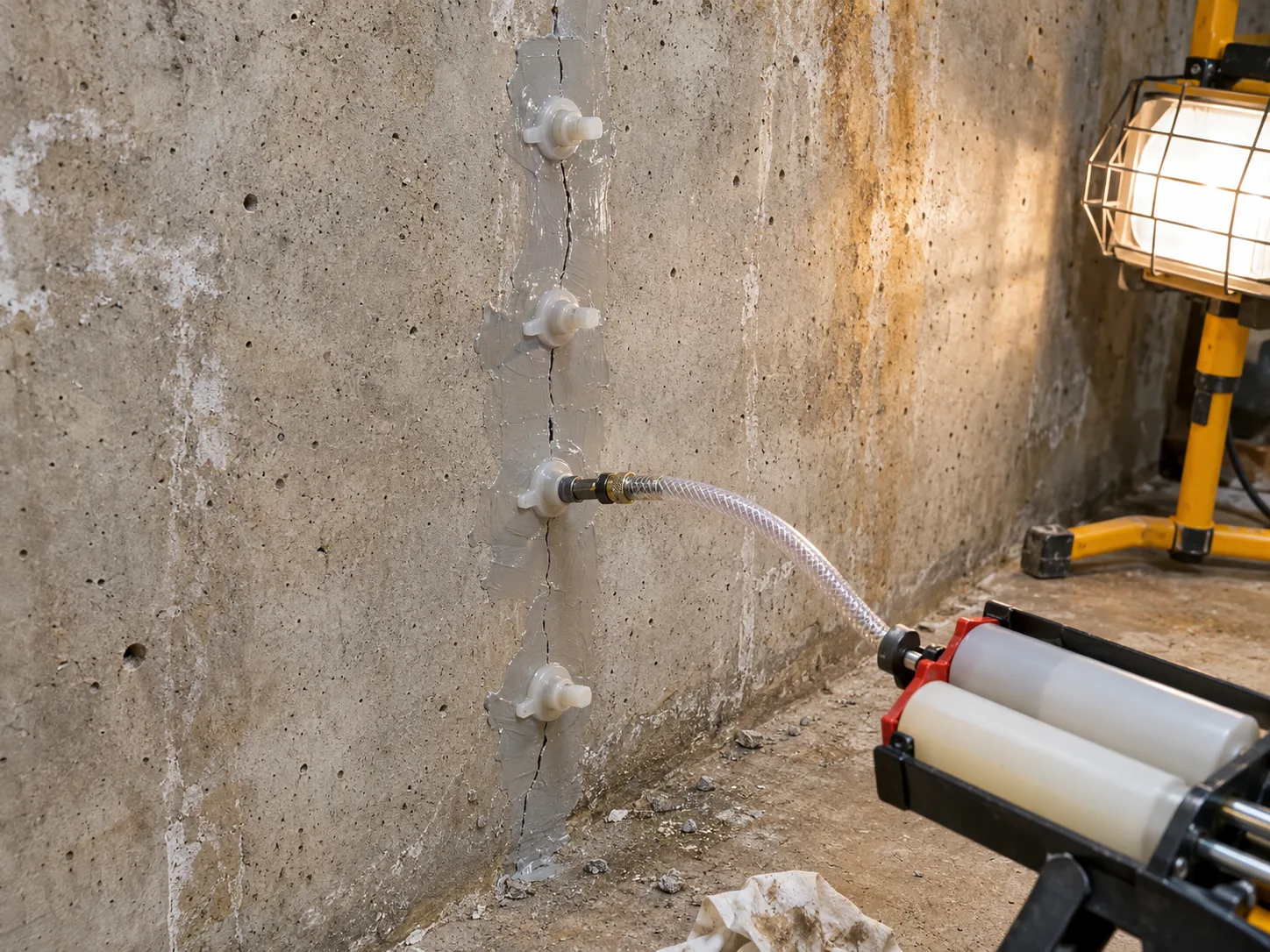
Most foundation cracks we see in East Stroudsburg are vertical hairlines running from the top of a poured concrete wall down toward the footer, usually 1/16 to 1/4 inch wide. These are almost always shrinkage cracks from the original pour, and they start leaking a few years later once the backfill settles and ground water finds the path. The right fix is a low-pressure polyurethane injection: we clean the crack, set injection ports every 8 inches, cap the surface with a fast-set paste, then inject hydrophobic polyurethane resin from bottom to top until it foams out the next port. The resin expands 8 to 10 times its liquid volume and chases the crack full-depth to the exterior soil.
Horizontal cracks are a different animal and need a real inspection before anyone talks price. A horizontal crack 3 to 4 feet up a block or poured wall usually means hydrostatic pressure from a saturated backfill zone pushed the wall in during a wet season. On Pocono mountain homes off Route 611 that sit against a hillside this is common because the uphill soil holds water against the wall through 4 to 6 weeks of spring snowmelt. Active horizontal cracks need carbon fiber straps or steel I-beams anchored top and bottom to the slab and the sill plate before any injection or coating goes on. Skipping the structural reinforcement and just filling the crack means the wall keeps moving and the crack reopens the next spring.
Block foundations behave different than poured concrete. Block cracks run along the mortar joints in a stair-step pattern and injection resin does not work the same way because the cavities fill with water inside each block. The fix for a leaking block wall is usually a combination of exterior membrane, interior cove joint drain, and hydraulic cement tuck-pointing on the visible joints. On the oldest East Stroudsburg homes around Dansbury and the Smith Street corridor we also see cut stone and rubble foundations where the mortar has washed out entirely. Those get a parge coat of fiber-reinforced hydraulic cement over the inside face plus an interior French drain to catch what still gets through.
The mistake we see most from cheap handymen here is caulking a leaking crack with silicone or asphalt-based crack filler from the hardware store. Those products have zero bond strength against hydrostatic pressure and they trap water behind the patch, which accelerates spalling and rebar corrosion in the wall. The other mistake is injecting an active horizontal crack without first adding carbon fiber or steel. Both approaches fail within one or two freeze-thaw cycles. We never inject an active horizontal crack without reinforcing first, and every injection comes with a lifetime product warranty on the resin plus our own workmanship warranty on the install.
What we handle
Polyurethane Crack Injection
Hydrophobic polyurethane resin injected under low pressure through surface ports. Expands 8 to 10 times, chases the crack full-depth, and stays flexible through freeze-thaw cycles.
Epoxy Crack Injection
Structural epoxy for dormant hairline cracks where we need to weld the two sides of the wall back together. Used when the crack is not actively moving and strength matters more than flexibility.
Carbon Fiber Wall Reinforcement
Woven carbon fiber straps epoxied from floor to sill plate on bowing or active horizontal cracks. Stops further movement without the demo of steel I-beams.
Emergency Active Leak Injection
Same-day call for a crack pouring water during spring snowmelt. We drill, port, and inject with water running, the polyurethane cures wet and seals on contact.
Block Foundation Tuck-Point and Parge
Fiber-reinforced hydraulic cement over the interior face of leaking block or rubble stone walls, common on Dansbury and Smith Street corridor homes with original 1900s foundations.
Horizontal Crack Structural Repair
Carbon fiber or steel I-beam reinforcement before any injection or coating. Required on active horizontal cracks caused by hydrostatic pressure on Pocono hillside homes.
How the job goes
1. On-Site Inspection
We measure crack width with a feeler gauge, check for active movement with a crack monitor, probe for exit water on the opposite face, and photograph everything. Inspection takes 30 to 45 minutes.
2. Written Per-Crack Quote
Each crack gets priced individually with the recommended repair method, carbon fiber or injection only, materials used, and warranty terms in writing before anything starts.
3. Surface Prep and Port Set
We grind the surface clean, set 3/8 inch injection ports every 6 to 8 inches down the length of the crack, then cap the full crack with a fast-set paste that cures in 20 minutes.
4. Resin Injection
Low-pressure injection from bottom to top, pumping until resin foams out of each next port. Typical 7-foot crack takes 15 to 30 minutes of actual injection time.
5. Port Removal and Cleanup
Ports grind off flush the next day after the surface paste fully cures. Finish is a thin gray stripe where the crack was. You get the warranty paperwork and photos before the truck leaves.
What's included
- Measurement with feeler gauge and crack monitor photo baseline
- Written per-crack quote with repair method and warranty
- Hydrophobic polyurethane or structural epoxy resin, contractor-grade
- Injection ports every 6 to 8 inches down the crack
- Fast-set surface paste to cap the crack face
- Low-pressure electric injection pump, not a caulk gun
- Carbon fiber straps on cracks that need structural reinforcement
- Lifetime product warranty on the resin plus workmanship warranty on the install
What it costs
Polyurethane crack injection runs $400 to $1,500 per crack in East Stroudsburg. Carbon fiber reinforcement runs $500 to $900 per strap. Free on-site inspection.
| Job | Typical price | Notes |
|---|---|---|
| Polyurethane Injection (per crack) | $400, $1,500 | Vertical hairline under 5 feet at the low end, wide 8-foot active crack at the top. |
| Epoxy Structural Injection (per crack) | $600, $1,800 | Higher material cost and longer cure time than polyurethane. |
| Carbon Fiber Strap (per strap) | $500, $900 | 4 to 6 straps per active horizontal crack is typical, spaced 4 feet on center. |
| Block Wall Tuck-Point and Parge | $1,800, $6,500 | Linear footage of mortar joint plus parge square footage drives the number. |
| Free On-Site Inspection and Per-Crack Quote | Free | Each crack measured and priced individually with written scope on the spot. |
Ranges are typical for Foundation Crack Repair jobs in East Stroudsburg and confirmed with an exact written quote before any work starts.